
Emotional Patterns • Leadership • Relationships
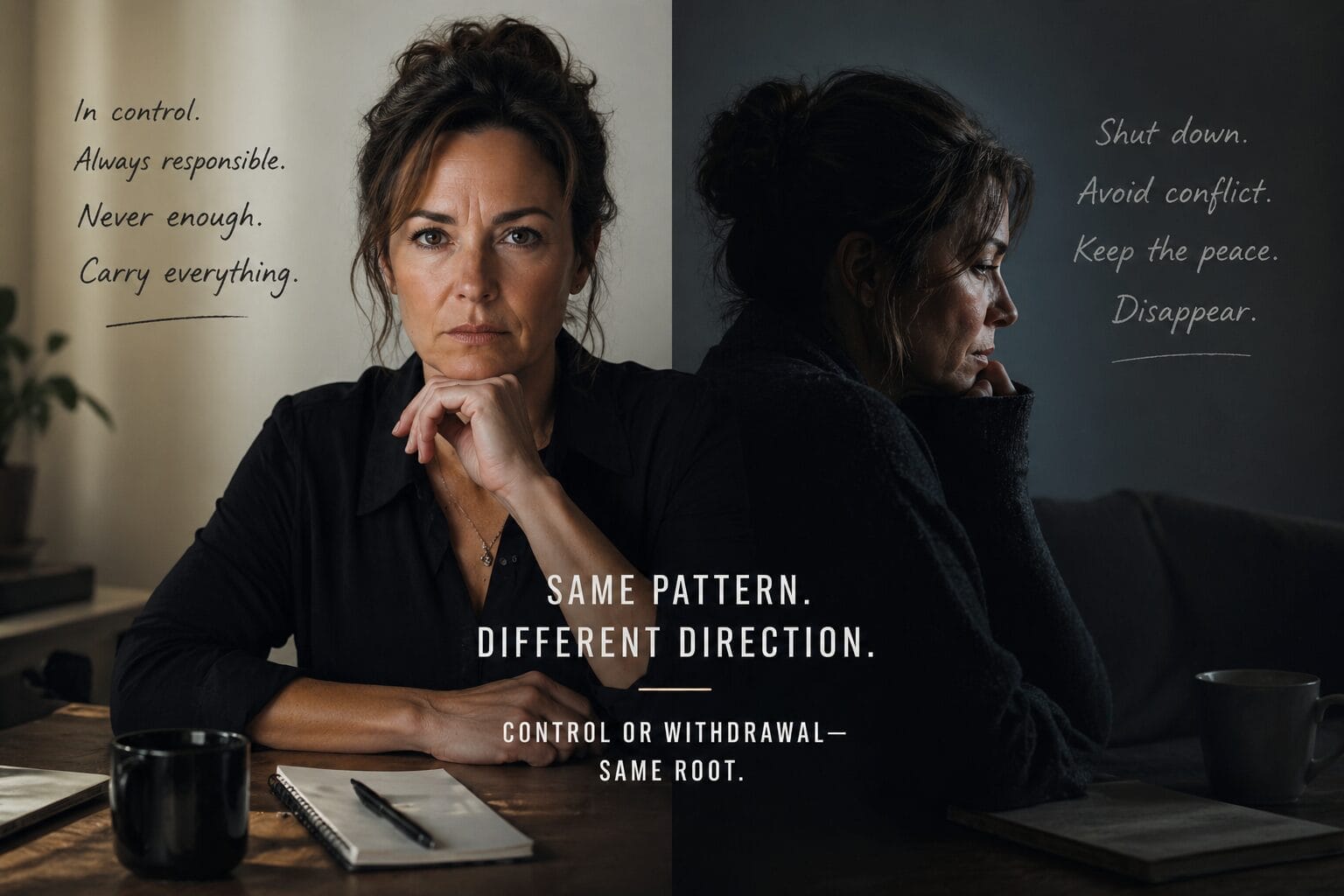
Most people think control and shutdown are different problems. Often, they are opposite expressions of the same emotional pattern.
Some people move toward discomfort by taking over. Others move away by going quiet. The behavior changes. The protective purpose does not.
One root. Two expressions.
CONTROL ← PROTECTION → SHUTDOWN
One person tries to create safety by managing everything. Another tries to create safety by disappearing from the pressure.
The Behavior Is Not the Root
Awareness helps you notice the surface: “I over-function.” “I avoid.” “I people-please.” “I shut down.” But pattern expression asks a deeper question:
Why does protection move in this direction for me—and in the opposite direction for someone else?
When you treat the expression as your identity, you try to fix the behavior without understanding what drives it. That is why patterns can return as overwork, withdrawal, indirect communication, or passive-aggressive behavior.
The Root Is Protection
Control is not the root. Avoidance is not the root. Both are strategies the nervous system learned to use when something felt uncertain, unsafe, exposing, or emotionally costly.
It’s not who you are. It’s what worked.
Early experiences become emotional lessons. Those lessons become beliefs. And those beliefs shape how you respond long after the original situation is gone. The Emotional Pattern Framework™ helps you trace that sequence instead of judging the final behavior.
One Pattern, Two Directions
The same emotional lesson can produce opposite-looking responses. The direction depends on what once created the greatest sense of safety: becoming more active and responsible, or becoming less visible and exposed.
Expression One
Over-Functioning / Control
You may:
- stay in control
- overthink every decision
- take on too much
- struggle to ask for help
- feel responsible for everyone and everything
Other people may see strength, competence, and reliability. Underneath can be pressure, fear that things will fall apart, and a belief that you must stay ahead of every problem.
Expression Two
Under-Functioning / Shutdown
You may:
- go quiet during conflict
- avoid difficult conversations
- pull back when things feel uncertain
- communicate indirectly
- wait for someone else to take the lead
Other people may see calm, flexibility, or easygoing behavior. Underneath can be discomfort with tension, fear of saying the wrong thing, and a need to avoid exposure.
How the Two Expressions Reinforce Each Other
A control-based person often pairs with someone who withdraws. At first, it can feel like balance: one leads and the other accommodates. Over time, it becomes a loop.
The more one controls, the more the other withdraws.
The more one withdraws, the more the other controls.
Neither person feels understood, and both feel justified. That is one reason relationships can feel so hard even when both people care.
Why It Feels So Personal
Because these responses are automatic, they can feel like personality: “I’m just the responsible one,” or “I’m just not confrontational.” But a protective pattern is not a fixed identity.
Understanding the pattern does not remove responsibility. It makes responsibility more useful. Instead of asking, “What is wrong with me?” you can ask, “What is this response trying to protect—and what would a healthier response look like now?”
Why Behavior Change Alone Fails
Better communication, clearer boundaries, and practical tools matter. But when the underlying pattern still reads discomfort as danger, the old response keeps returning.
Awareness can name the pattern. Change happens when you can interrupt it in real time. Patterns do not break at the point of understanding; they break at the point of response.
Emotional Sobriety Creates Choice
Emotional sobriety is not control, and it is not avoidance. It is the capacity to stay present long enough to choose.
- Notice the protective response
- Pause before acting it out
- Tolerate the discomfort underneath it
- Choose a response that fits the present—not the past
The goal is not to become less capable or more confrontational. The goal is to become less automatic.
The Framework in Real Life
Your expression is the visible part of the pattern.
The Emotional Pattern Framework™ helps you trace the path from childhood experiences to emotional lessons, life scripts, survival responses, and adult patterns—so you can change the outcome instead of managing the symptom.
Your Next Step
See which pattern is running.
The Life Script Questionnaire helps you identify the belief beneath your most familiar response—and the cost of continuing to live from it.
When discomfort appears, do you move toward control—or away into shutdown?
