

- Updated: October 8, 2026
You weren’t looking for a new identity.
You were just scrolling.
Then you saw someone with the body, home, marriage, morning routine, wardrobe, or confidence that seemed to prove life could feel better than yours does right now.
At first, it looked like inspiration.
Then, almost without noticing, you began treating someone else’s visible outcome as a blueprint.
Maybe you bought the candle, downloaded the guide, copied the routine, or started questioning choices you had felt perfectly comfortable with an hour earlier. Not because the person forced you. Because their life looked complete—and yours suddenly felt unfinished.
That is the lifestyle trap.
It turns another person’s curated life into evidence that they know how you should live yours. Their confidence starts to feel like authority. Their before-and-after starts to look like a method. And everything that helped produce their outcome—money, support, access, timing, health, opportunity, and luck—disappears behind the image.
This isn’t harmless inspiration.
The more you consume someone else’s version of success, the harder it becomes to hear your own instincts. You start stitching together borrowed aesthetics and calling it identity. You perform a life that looks aligned while becoming increasingly disconnected from the one you actually want.
Not because you’re shallow.
Because you’re tired. Disoriented. Maybe under-supported. And hoping that a more beautiful life might finally feel like a more meaningful one.
Lifestyle fantasy doesn’t just waste your money.
It slowly teaches you to distrust yourself.
What We're Unpacking
✨ How Influencer Culture Replaces Your Inner Compass
It didn’t happen overnight.
One scroll. One “must-have” list. One aspirational podcast that told you what morning routine equals success.
And slowly, without realizing it, you stopped hearing your own voice.
You outsourced your instincts to someone who felt more certain.
You started curating instead of connecting.
Not because you’re weak.
Because you’re human—and high-functioning humans are often the easiest to fool.
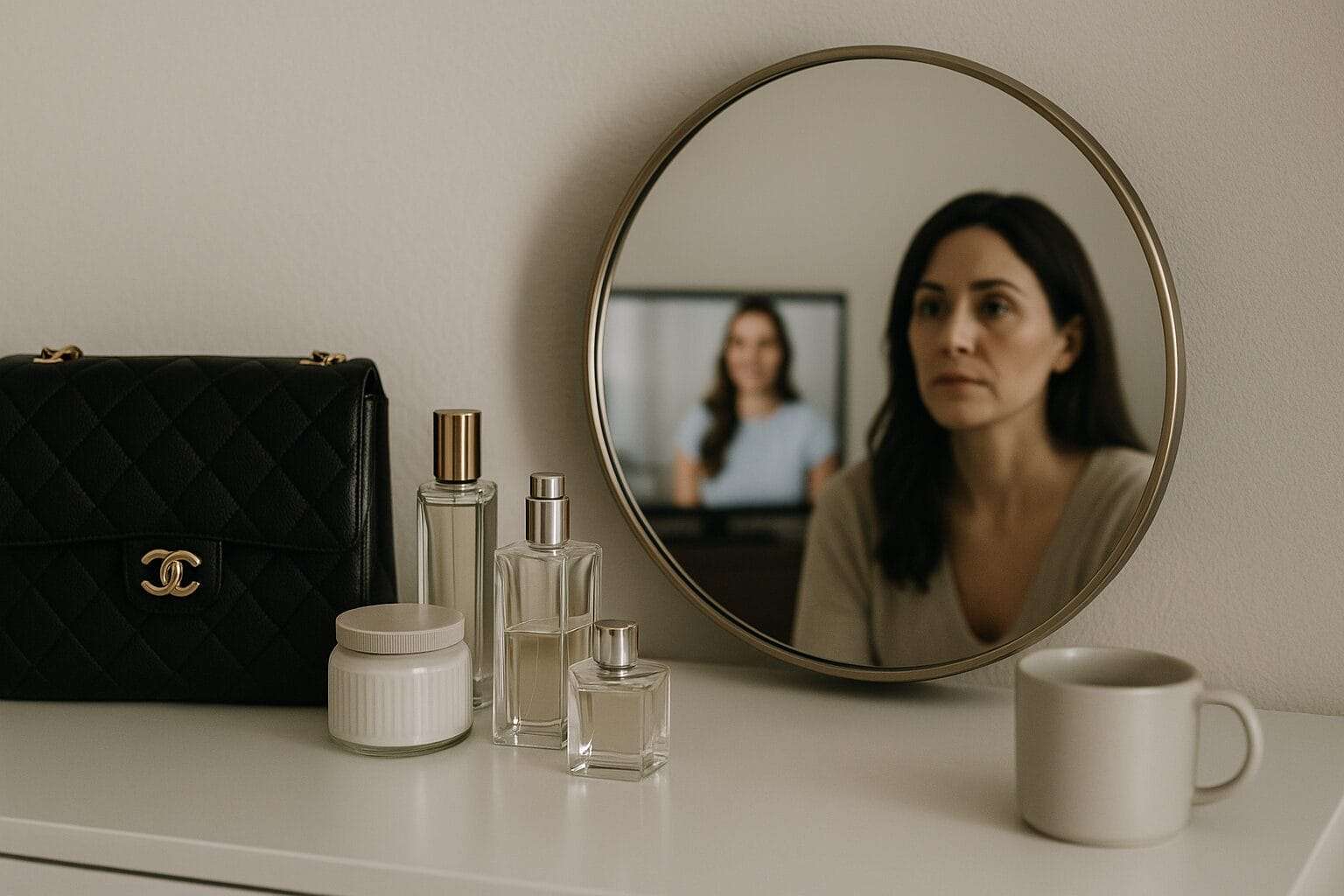
Especially when you’ve built an identity around having it together.
And here’s the most dangerous part:
The version of you that’s performing well?
She’s not a fraud.
She’s just fragmented.
She knows how to deliver.
She knows how to rise.
She just forgot how to listen to herself without needing it to look like a win.
Dr. Mark Johnson, a media studies professor, notes:
“These one-sided relationships create a sense of intimacy and trust. When an influencer recommends a product, it feels like advice from a friend rather than an advertisement. This blurs the line between genuine connection and marketing, making people more susceptible to influence.”
This is how it happens.
Not with a breakdown.
But with the slow, subtle loss of your own authority.
🔥 Why Lifestyle Fantasy Is So Hard to Recognize
If lifestyle fantasy is so hollow, why hasn’t it collapsed?
Because it’s not just trendy.
It’s strategic.
It’s emotional marketing at its most sophisticated—and most profitable.
Let’s name the real reasons this illusion still holds power over smart, capable women:

💸 1. It Sells Because You Want to Believe
From $300 dresses to $1,400 “cozy” couches, the real product isn’t the item—it’s the illusion of arrival.
The dream is always:
“If I buy this, maybe I’ll feel like her. Calmer. Cleaner. More grounded.”
Calling that a fantasy threatens the whole marketing machine.
Because fantasy sells better than self-trust ever could.
🪞2. Admitting It’s Fake Feels Too Exposing
Deep down, most people know it’s curated. But if you call it fantasy, you’re forced to confront something uncomfortable:
You weren’t just watching—you were participating.
You were emotionally aroused by someone else’s filtered life.
You shaped your desires around their image.
And you used adult money to play pretend.
No one wants to admit that. So we rename it:
“Aspiration.”
“Vision boarding.”
“Just a little inspiration.”
📱3. It’s So Normal, We’ve Stopped Noticing
When everyone’s curating—branding, filtering, soft-launching their lifestyle—it stops looking fake. It becomes the standard.
We’ve aestheticized the mundane to the point where a cluttered desk or tired face feels wrong.
And when false becomes the norm, authenticity starts to feel like an interruption.
🤐 4. The Critics Are Complicit
Even the voices who could speak up—writers, podcasters, coaches—often depend on the same ecosystem they’d be critiquing.
They don’t wear Shein. They have better taste.
But the message is still:
“Follow me. I’ve figured life out. Here’s how you can too—for $49.99 or through these affiliate links.”
To call out the fantasy would mean dismantling the platform they built it on.
🎭 5. It Feels Like Inspiration—But It’s Just Another Form of Numbing
You think you’re being inspired.
You tell yourself it’s motivation.
But more often than not, it’s just prettier escapism.
And when you’re emotionally exhausted, the scroll hits like a sedative.
Not because it heals you—because it suspends you.
The real question isn’t whether you’re watching too much.
It’s this:
Are you consuming to expand your life…
or to distract yourself from the one you’re in?
👀 When the Before-and-After Becomes the Credential
Some people never explain why they are qualified to guide anyone. Their qualification is the visible outcome:
Look at my body. Look at my marriage—or the one I escaped. Look at my money, my home, my confidence, my new relationship. I changed my life, so follow me and I’ll show you how to change yours.
That story can be completely sincere and still be dangerously incomplete.
A personal outcome is evidence that something happened for one person. It is not proof that the person correctly understands everything that caused it—or that the same path will work for someone else.
The internet compresses transformation because the complete story is harder to sell. A clean before-and-after doesn’t show you:
Desire: How badly did this person already want to change? Were they emotionally ready before the visible transformation began?
Resources: Did they have money, time, transportation, healthcare, childcare, housing stability, or access to professional help?
Support: Who encouraged them, trained them, listened to them, protected their time, or helped them recover when things became difficult?
Perception: What did they decide the change meant? Did one event truly cause the transformation—or did it become the easiest way to explain a much more complicated season?
It also leaves out timing, health, temperament, opportunity, luck, and everything that didn’t photograph well.

We see the person who made the change and built a platform around it. We rarely see the people who made similar choices, worked just as hard, and experienced a different outcome. Their stories don’t become transformation montages. They disappear from the evidence.
That’s how survivor bias becomes marketing.
Lived experience matters. It can create empathy, recognition, and hard-earned wisdom. But lived experience is a data point—not automatically a method.
“This happened to me” and “I understand how to guide you through it” are not the same credential.
A person may understand their own experience deeply without understanding your body, marriage, finances, emotional history, support system, or goals. Their outcome may inspire you. It should not automatically overrule your discernment.
And there’s another side of the story worth examining. If you’re the person who wants to become influential rather than the person following an influencer, have you considered the hidden costs of becoming known? The public image may be appealing, but the daily experience of maintaining it deserves just as much consideration.
When Kindness Clouds Clarity
I experienced this in a much smaller but revealing way with a popular hair creator.
She spoke with such warmth and sincerity that I felt as though she genuinely cared about helping people heal their relationship with their hair. But her feed was wall-to-wall heat styling—flat irons, Marcel combs, and tension passes—while she insisted that she personally used heat only every six to eight weeks.
The visuals and the claims didn’t match.
For a moment, I felt that familiar tug:
Maybe I should trust her confidence more than my own instincts.
That’s the trap.
Not necessarily manipulation—misalignment packaged as authority.
Influencers rarely deceive on purpose. Many may not recognize how their curated output contradicts or oversimplifies their lived reality. But the viewer still pays the cost of that contradiction.
This time, I caught it. I felt the dissonance, named it, and stepped back.
Not because she was wrong.
Because her content was not aligned with my goals, my biology, or the wisdom I had already earned by paying attention to my own experience.
Warmth can make someone feel trustworthy. A beautiful outcome can make someone appear authoritative. Neither one releases us from the responsibility to think.
🧍♀️ What the Lifestyle Trap Looks Like in Real Life
Let’s make this personal.
Here’s how lifestyle fantasy hijacks even the sharpest among us:

🧥 The $400 Sweater Spiral
Sarah, 35, Marketing Executive
“I bought that Jenni Kayne sweater Meghan Markle wore. Told myself it was an investment piece. Truth? I was hoping it would make me feel elegant and put-together. Spoiler: I’m still me—just with less money in the bank.”
📱 The Influencer Upgrade Illusion
Tom, 28, Graphic Designer
“I followed this tech guy who had all the latest gear. Maxed out my credit card trying to keep up. I thought it would make me better at my job. Turns out, tools can’t replace skill—or self-worth.”
🧍♀️ The Mommy Blogger Mirror
Jenny, 42, Small Business Owner
“I obsessed over a lifestyle blogger who seemed to have it all. Perfect house, perfect wardrobe, perfect rhythm. One day I realized—I was mimicking her life instead of living my own.”
These aren’t just money regrets.
They’re signs of a deeper erosion—when leadership clarity gets blurred by emotional outsourcing.
And if that hit a little too close to home?
You’re not broken.
You’re just waking up.
In the next section, we’ll talk about what this kind of wake-up costs—and what it might finally set you free to reclaim.
💔 The Emotional Cost of Aesthetic Performance
Lifestyle fantasy isn’t just a bad shopping habit.
It’s a slow leak in your emotional authority.
The more you consume someone else’s life, the harder it becomes to lead your own. You start second-guessing your rhythms. You perform presence instead of feeling it. You decorate your life like a set—and then wonder why it doesn’t feel like home.
Success becomes something you arrange rather than something you experience.
The clean desk. The perfect light. The coffee cup placed just right. The wardrobe, morning routine, home, and language borrowed from people whose confidence appears more trustworthy than your own instincts.
It looks like inspiration.
But slowly, aesthetic alignment begins replacing emotional alignment.
And here’s the part no one talks about:
You can be fully functional and still be deeply lost.

You can lead meetings, manage a team, raise a family, and handle everything expected of you—while becoming increasingly disoriented inside your own life. From the outside, you appear successful. Inside, you are performing a version of success that quietly exhausts you.
The cost isn’t only financial.
It’s your clarity.
Your voice.
Your emotional stamina.
Your ability to recognize what you actually want before someone else presents a more photogenic answer.
This isn’t about bashing influencers or blaming an algorithm. It’s about noticing what happens when polish carries more authority than truth. When confidence becomes confused with consumption. When your leadership voice starts sounding more like your favorite podcast host than your actual self.
Eventually, you stop trusting yourself.
Not because you failed.
Because you fed your self-trust to the algorithm one scroll, purchase, copied routine, and borrowed desire at a time.
You don’t necessarily need a digital detox.
You need to reclaim the parts of yourself you handed over—the preferences you dismissed, the rhythms you questioned, and the internal signals you overruled because someone else’s life looked more complete.
Once you recognize that loss, you can choose differently.
You can admire another person’s life without treating it as instructions for your own.
🪞 When Protecting the Image Starts Costing More Than the Image Is Worth
There is a point where lifestyle fantasy stops being about what you buy.
It becomes about what you are willing to do to keep the story alive.
At first, the gap may seem harmless.
You spend a little more than you should.
You stay in the house, the membership, the wardrobe, the social circle, or the business model longer than your finances can comfortably support.
You tell yourself things will improve next month.
You just need one more client. One more deal. One more opportunity.
But when your identity becomes attached to looking successful, reducing your lifestyle can start to feel less like a financial decision and more like a personal collapse.
You are no longer asking:
Can I afford this?
You are asking:
What will it say about me if I stop?
That is where things can get dangerous.
Because once protecting the image becomes the priority, reality starts becoming negotiable.
You rationalize.
You borrow.
You hide.
You exaggerate.
You make promises you cannot comfortably keep.
You lean harder on people who have money, access, influence, patience, or affection.
Sometimes you may not even think of yourself as using them.
You tell yourself they want to help.
They can afford it.
You have helped them before.
This is temporary.
You will straighten everything out later.
And perhaps every individual decision seems explainable.
But zoom out.
What is happening to your relationships?
Your finances?
Your integrity?
Your ability to tell yourself the truth?
This is how someone can become incredibly sophisticated at managing appearances while becoming increasingly disconnected from consequences.
The problem is not that they cannot see the wreckage.
Often, the wreckage has simply become less threatening than losing the identity.
Admitting, I cannot afford this anymore, may feel unbearable.
Admitting, I am not as successful as I have presented myself, may feel worse.
Admitting, I need to change my life, may mean confronting years of decisions built around maintaining an image.
So instead, another arrangement gets made.
Another explanation.
Another favor.
Another workaround.
And the more complicated your life becomes, the more fiercely you may defend the very image creating the complication.
That is why lifestyle fantasy is not merely a consumer problem.
It can become an integrity problem.
Your life slowly reorganizes itself around protecting the appearance of success instead of building something sustainable underneath it.
And eventually, the question is no longer whether the lifestyle looks impressive.
It is:
What are you sacrificing to keep other people believing the story?
⛔ How to Reclaim Your Authority From Influencer Culture
You don’t have to unsubscribe from every email list.
You don’t have to throw out the sweater or delete your Pinterest boards.
But you do have to stop pretending the fantasy didn’t change you.
Because it did.
It softened your boundaries.
It numbed your discernment.
It hijacked your clarity and dressed it up as “aspiration.”
But here’s the truth no one profits from saying:
You don’t need a prettier life.
You need a more honest one.
One you can lead from.
One that doesn’t crumble the moment you stop performing.
This isn’t about shame.
It’s about recovery.
From aesthetic addiction.
From emotional outsourcing.
From the myth that identity is something you can buy your way into.
You were never broken.
Just buried under someone else’s vision board.
It’s time to come home.
If you’re done outsourcing your confidence—and ready to rebuild something real—
💛 Work with me, Denise G. Lee – I help high-performing leaders untangle the emotional patterns beneath burnout, performance, and aesthetic addiction.
👉 Start your healing here
🎙️ Prefer to listen first?
My podcast shares honest, no-fluff conversations on emotional sobriety, trauma recovery, and leading with clarity.
👉 Explore the Introverted Entrepreneur
And remember—
The world will always sell you a version of success that looks good in photos.
But leadership?
Real leadership?
Is built in the moments no one sees.
Choose that life.
Not the filtered one.


