

- Updated: April 18, 2025
You made it through.
But something still doesn’t feel right.
Instead of relief, there’s a quiet weight you can’t explain.
A sense that you should be grateful—but aren’t.
That tension has a name.
And it’s not weakness.
It’s survivor’s guilt.
🧠 Survival Isn’t Always a Relief
Survivor’s guilt isn’t just about extreme trauma.
It shows up in quieter ways—
when you’re the one who made it through,
but something in you still feels unsettled.
Instead of relief, there’s a weight you can’t explain.
A lingering sense that you should feel grateful—but don’t.
It sounds like:
“Why me?”
“Why did I get to walk away?”
“What more could I have done?”
Survivor’s guilt is often associated with disasters, accidents, or violence.
But you don’t need to be in a war zone to carry it.
It can show up in everyday moments of contrast and loss—
especially if you’re a high-functioning leader
who’s learned to push forward no matter the emotional cost.
🧩 “Guilt is the price we sometimes pay for survival—not because we did anything wrong, but because we’re still here.”
— adapted from trauma psychology insights
This doesn’t always show up the way you expect.
Sometimes, it looks like this:
🧍♂️ Story of Survivor’s Guilt
⚠️ Note: This story contains references to gun violence. Reader discretion advised.

🏡 A Small Town Shattered
In a quiet town where people still leave their doors unlocked and wave at strangers, Raul ran a modest hardware store. He and his wife Claire had built a simple life. Their youngest daughter, Tiffany, was still in high school while their two older kids were off at college.
That morning started like any other.
Until the phone rang.
Raul ignored it at first, assuming it was another vendor or a customer inquiry. But when it rang a third time—then a fourth—he picked up.
Claire was sobbing.
“There was a shooting at Tiff’s school. They evacuated everyone. She’s okay—I’m going to get her right now.”
Raul barely registered the words. His mind went blank. His body froze. He mumbled something back—something like “Just get her home.”
But inside, he was spiraling.
💔 Gratitude Meets Guilt
A former student had stormed Tiffany’s school with an assault weapon. There were multiple casualties before law enforcement subdued the shooter. Tiffany had been in the pool during the attack—miles away emotionally, but just yards from the violence.
One of her closest friends didn’t survive.
That night, no one in Raul’s house slept.

Raul did what good people do: he donated, showed up at the memorial, and quietly helped raise money for the grieving families.
But internally, he was unraveling.
He lost 25 pounds in two months—not from dieting, but from a lack of appetite and overwhelming shame. He was later diagnosed with PTSD. And while his daughter survived, his guilt didn’t.
“Why did we get to keep our daughter? Why couldn’t I protect the others?”
Once we believe we cannot do enough, that is usually when we go above and beyond what is needed and necessary.
Denise G. Lee Share on X
😔 Trauma Response in Disguise
Raul’s version of survivor’s guilt looked like overfunctioning, emotional numbing, and self-punishment—all common trauma responses that masquerade as “coping.”
This wasn’t just grief. It was a full-body, full-soul breakdown of his internal compass.
👉 Is It a Trauma Response or Intuition? Here’s How to Tell the Difference
He didn’t talk about it much. He just stopped engaging with his family emotionally. Threw himself into work. And when people thanked him for his generosity? It only made him feel worse.
Because in his mind, he didn’t deserve gratitude.

🧠 Why This Story Matters
Raul’s story isn’t just here to educate—it’s here to humanize. Healing doesn’t start with logic. It starts with naming.
👉 Healing Through Storytelling: A Path to Recovery and Connection
When we tell the truth about our guilt—when we bring shame into the light—it begins to loosen its grip. That’s why storytelling is powerful. It’s not just for catharsis. It’s for clarity. For connection. For healing.
Even when it feels overwhelming, emotional pain isn’t permanent—but it does demand to be acknowledged.
How Survivor’s Guilt Traps You in the Guilt Cycle
Everyone reacts to tragedy in many different ways. Guilt is one of the ways to respond to it; however, if you are not careful, it can easily take you to a place of misery.
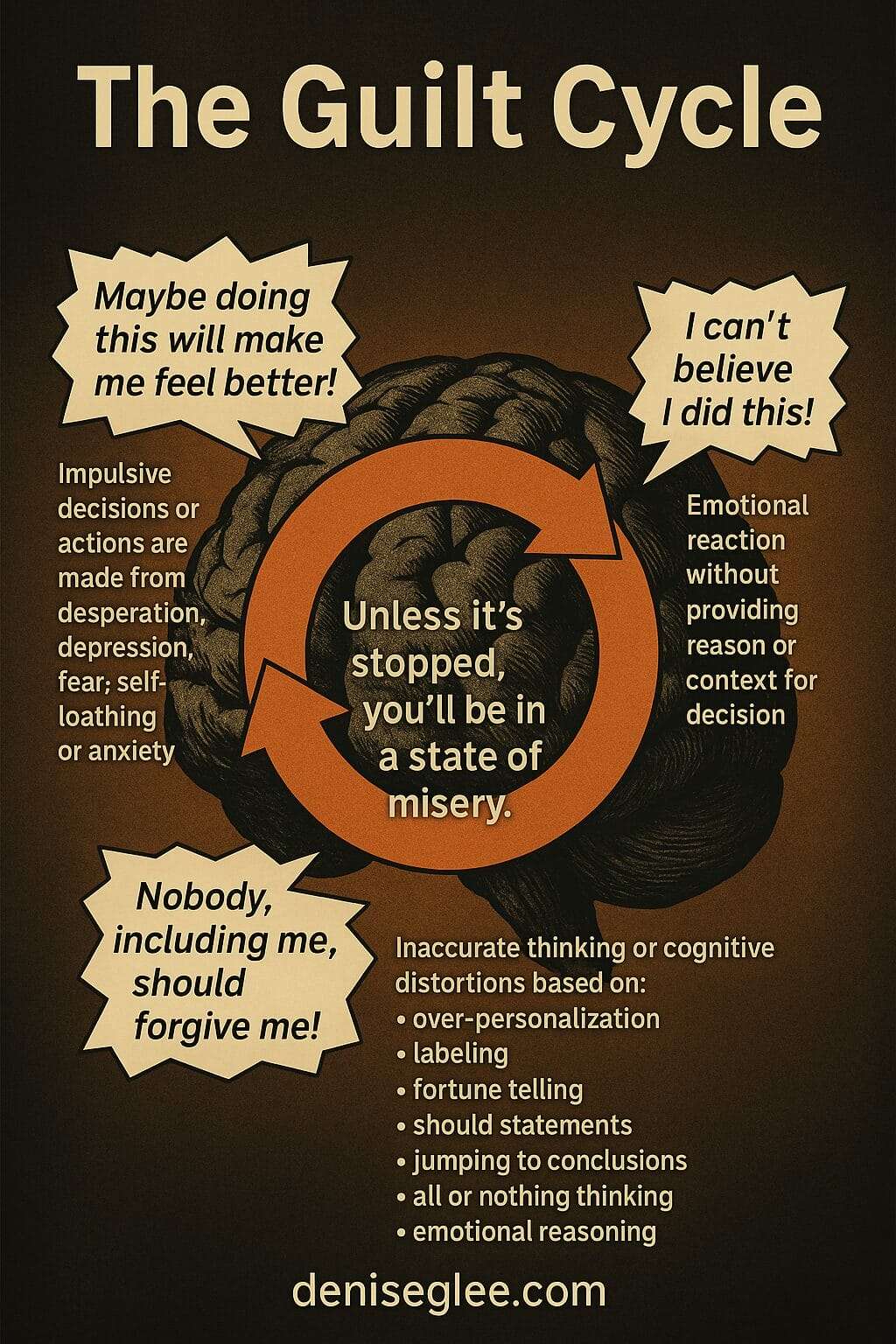
Here is a brief example of the guilt cycle through Raul’s story.
A triggering event that causes an emotional reaction. Raul was initially shocked and quickly spiraled into despair.
Next, Raul created a false narrative to justify his irrational state of mind. He labeled himself as not “doing enough,” shaming himself because his daughter lived while so many other parents lost their children.
Finally, Raul decided to assuage his guilt by not eating (punishing himself for living) and donating his time excessively while emotionally abandoning his family when they needed him most.
The guilt cycle is shown below pictorially.
From Guilt to Misery: Why You Can’t Just ‘Move On’
If we’re not careful with how we process pain, guilt doesn’t just sit in the background. It festers, spirals and then it can drag us into a cycle of misery—quietly but powerfully.
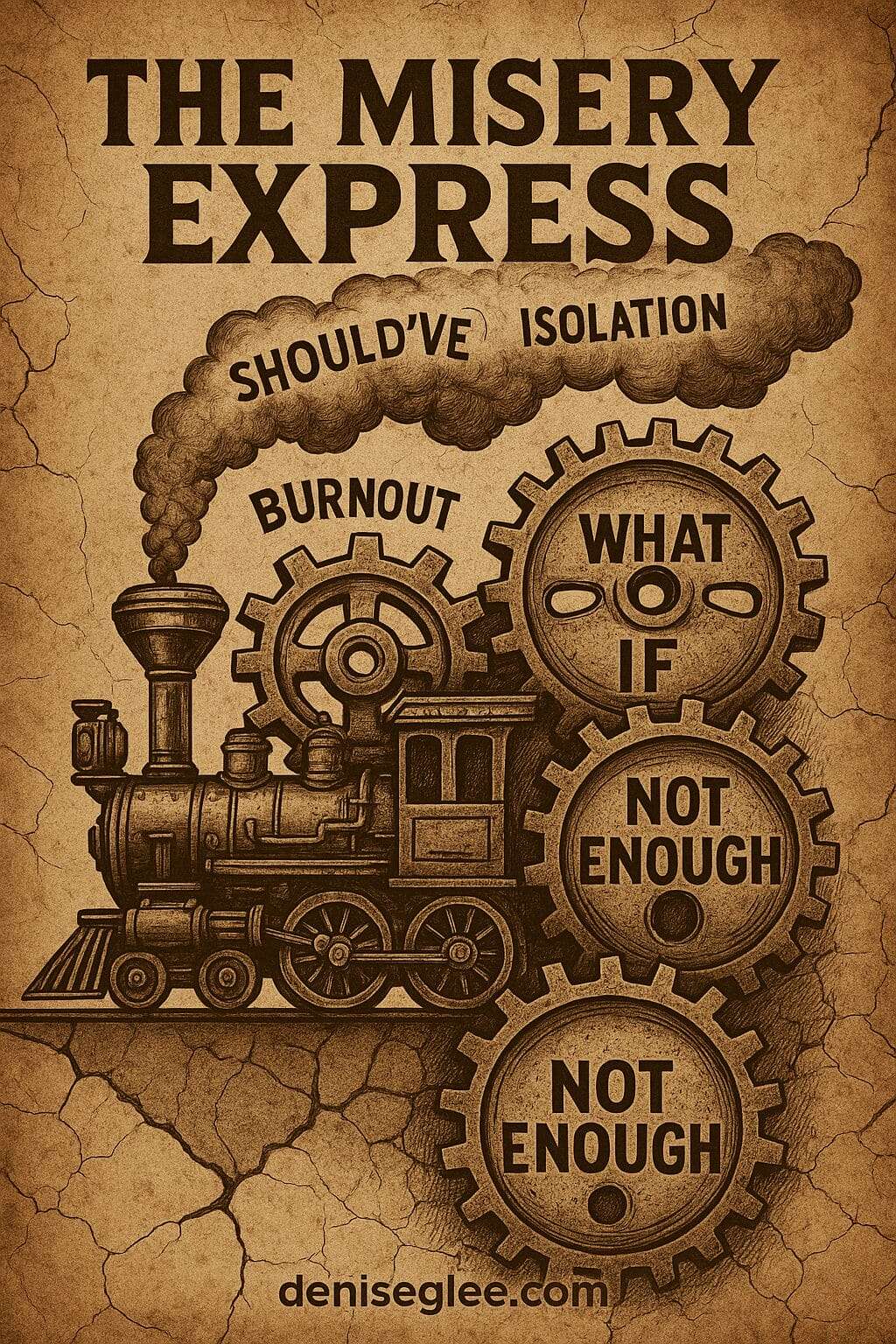
I call it the Misery Train.
Once guilt takes the wheel, we often find ourselves trapped in one of three emotional states: depression, anxiety, or shame. You might not even realize it’s happening. It doesn’t announce itself—it just quietly reroutes your energy, your mindset, and your sense of self.
🛤️ The Misery Train Has Three Destinations:
Depression:
“Everything I do is pointless.”
A heavy, hopeless fog that makes even the simplest tasks feel futile.Anxiety:
“If I mess this up, it’ll all come crashing down.”
A frantic attempt to stay ahead of disaster, even when no one’s chasing you.Shame:
“If they really knew me, they’d walk away.”
A belief that you’re fundamentally flawed, unlovable, or unworthy.
Here’s what it looks like when guilt drives the train—and where it tends to go.
How to Break Free from Survivor’s Guilt
If guilt is the engine of the misery train, your thoughts are the tracks.
To get off that train, you have to challenge your thoughts—every single one. Because guilt doesn’t usually shout. It whispers things like, “You didn’t do enough,” or “You don’t deserve to feel okay.” And if you don’t question those whispers, they start running the whole show.
Psychologist Dr. David D. Burns put it like this:
“The greatest weapon against stress is our ability to choose one thought over another.”
The confidence you’re looking for isn’t something you find—it’s something you build, one decision at a time, because self-trust is built, not found.
Here’s how you start choosing better ones.
🧠 Thought-Check Questions That Can Shift Everything
If survivor’s guilt or emotional overwhelm has hijacked your inner dialogue, these questions will help you pause, reframe, and redirect. Each one is a mini-intervention—small but powerful.
1. How is this thought helping—or harming—me right now?
Is it moving you forward… or keeping you stuck in shame?
Maybe you’re thinking, “I should’ve done more.”
Pause. Ask yourself: What does that thought actually lead to?
If it inspires reflection or growth—great. But if it only leads to self-punishment, withdrawal, or obsessively overworking to “make up for it,” it’s keeping you in a shame loop, not helping you heal.
✔️ Why it’s helpful: This question reveals whether you’re operating from guilt-driven action or aligned intention. It breaks the illusion that pain equals progress.
2. What’s the actual worst-case scenario here?
Guilt loves to exaggerate. Fear adds drama. Clarity brings calm.
Let’s say you feel guilty for not checking in on a friend who’s going through a tough time. Your brain says: “They’ll never forgive me. I’m a terrible person.”
But what’s the worst-case reality? Maybe they’re hurt… or maybe they’re just overwhelmed too. Maybe a sincere message could bridge the gap.
✔️ Why it’s helpful: It shrinks the monster under the bed. It forces guilt to stop generalizing and face facts. Nine times out of ten, the fear isn’t as devastating as your nervous system thinks.
3. What small step could I take right now to interrupt this spiral?
You don’t need a master plan. You need motion. Even tiny shifts count.
You’re lying in bed replaying what you could’ve said differently in that hospital room… or that Zoom call… or that business decision. Instead of solving the entire thing in your head, you get up and stretch. Or you open your notes app and write one line: “I feel stuck right now, but I’m choosing compassion over critique.”
Surviving doesn’t make you responsible for what others lost—but it can make you question your right to move forward.
✔️ Why it’s helpful: Guilt paralyzes. But the antidote to stuckness isn’t perfection—it’s permission. Small, grounded actions break the trance and shift your state.

🔁 Start Healing—One Thought at a Time
Reclaiming your peace means reclaiming your thoughts. And you don’t have to do it alone.
According to the National Institute of Mental Health, nearly 1 in 5 adults experiences anxiety disorders. That’s not a flaw—it’s a flag. A sign that your nervous system has been through something. And healing? It’s not about “getting over it”—it’s about learning how to live through it differently.
“You have power over your mind—not outside events. Realize this, and you will find strength.”
— Marcus Aurelius
So here’s the truth: You are not broken.
You’re not too late.
And you’re not alone.
You’re simply in a moment where guilt has been too loud—and it’s time for your clarity to speak louder.
In the final section, I’ll leave you with some closing reflections—and a path forward.
Learn to Name What Hurts
If you’re struggling with survivor’s guilt—or you’ve been riding the misery train of shame, anxiety, or emotional exhaustion—I want you to know: I see you.
You’ve made it this far in the article. That means you’re not just surviving—you’re trying to understand what’s really going on underneath. And that’s powerful.
Healing doesn’t come from pretending you’re fine. It comes from naming what hurts, questioning the thoughts that keep you stuck, and taking one honest step at a time.
💛 Work with me, Denise G. Lee – Let’s get to the root of your emotional pain and build real tools for healing.
👉 Start here
You’re not broken or weak.
You’re simply carrying weight that was never meant to be yours forever.
Let’s lighten the load. Together.


