

- Published:
- Updated: August 6, 2026
Anger Is Information—Not Instruction
For a long time, I thought I had only two choices.
Swallow my anger and pretend I was fine.
Or let it take over the room.
Maybe you know that tension too.
You feel the heat rise in your body.
Your thoughts sharpen.
Every old disappointment suddenly joins the conversation.
And before long, anger is no longer pointing to the problem.
It is deciding what the problem means.
That is where things get dangerous.
Anger can tell you that something matters.
That a boundary may have been crossed.
That you feel dismissed, threatened, humiliated, disappointed, or unsafe.
But anger cannot always tell you why it happened.
It cannot automatically tell you what another person intended.
And it should not be allowed to make every decision that follows.
That is what I had to learn.
Reclaiming anger is not about becoming calmer for other people’s comfort.
It is not about suppressing what hurts.
And it is not about treating every emotional reaction as sacred truth.
It is about learning how to hear the signal without handing it control.
Because anger is information.
Not instruction.
It can help you understand what needs attention.
But you still have to decide what is true, what belongs to the present moment, and what response reflects the person you are trying to become.
That is the work this article will explore.
✨Your Emotional Clarity Guide
My Relationship with Anger
For a long time, anger was the emotion I trusted most.
It felt clear.
Protective.
Powerful.
When grief made me feel exposed, anger gave me somewhere to stand.
When fear made me feel small, anger made me feel strong.
When shame told me to disappear, anger helped me push back.
That made sense.
I grew up around anger.
Sometimes it was loud.
Sometimes it was cold.
Sometimes it showed up as silence, tension, intimidation, or emotional withdrawal.
But it was always there.
So I learned to speak its language.

What I did not understand was how often anger was protecting me from feelings I did not yet know how to hold.
Grief.
Helplessness.
Humiliation.
Disappointment.
The pain of not being heard.
The fear that nothing would change no matter how clearly I explained myself.
Anger gave those feelings shape.
It gave me movement when I felt trapped.
It helped me survive situations where softness did not feel safe.
But survival is not the same as freedom.
As I began doing deeper emotional work, I realized anger was not the enemy.
But it also was not always telling me the whole truth.
Sometimes it was responding to what was happening in front of me.
Other times, it was pulling old pain into the present and treating every frustration like evidence that the past was happening again.
That distinction changed everything.
I no longer needed to shame myself for feeling angry.
I needed to become curious about what the anger was protecting.
What felt threatened?
What had been violated?
What older wound had just been touched?
And what did the present moment actually require from me?
That is how my relationship with anger began to change.
Not by forcing it to disappear.
By learning to listen without automatically obeying it.
The Day My Boss Smiled
Years ago, I worked for a passive-aggressive boss who seemed to know exactly how to provoke people without ever appearing openly hostile.
He would undermine.
Dismiss.
Needle.
Then sit back and wait for the reaction.
One day, during a meeting, I gave him exactly what he wanted.
I raised my voice.
Pointed fingers.
Tried to prove that he was wrong.
“But he did it,” I said. “He was the one who caused this.”
And then he smiled.
Not because I had persuaded him.
Because I had lost control.

That moment stayed with me.
At the time, I thought my anger was helping me stand up for myself.
In reality, it had pulled me away from the very thing I needed most: the ability to think clearly and choose what happened next.
He remained calm.
I became the problem in the room.
And the more I tried to prove that my reaction was justified, the easier it became for everyone to focus on my behavior instead of his.
That did not mean he was innocent.
It did not mean my anger was irrational.
Something was wrong.
I was being treated poorly.
But my anger had stopped serving as information and started directing the scene.
It told me I had to make him understand.
That I had to force acknowledgment.
That if I became forceful enough, clear enough, or angry enough, the truth would finally win.
Instead, I left the meeting depleted.
I lost sleep.
My body stayed tense long after the conversation ended.
And the situation pulled me deeper into wounds that had existed long before I ever met him.
That was the harder realization.
My boss had not created all of the anger I brought into that room.
He had touched something older.
The helplessness of not being believed.
The humiliation of being dismissed.
The fear that someone could mistreat me and still control the story.
My anger was responding to the present.
But it was also carrying the past.
And because I could not yet separate the two, I reacted as though that meeting contained every moment I had ever felt powerless.
That is how anger can become your foil.
The emotion that once helped you survive begins interfering with your ability to protect yourself in the present.
You think you are fighting for your dignity.
But you may be surrendering your judgment, your energy, and your options to the person who provoked you.
Reclaiming anger does not mean pretending the other person did nothing wrong.
It means refusing to let their behavior decide who you become next.
When Anger Starts Writing the Story for You
My boss’s behavior was real.
So was my anger.
But the story my anger created around that moment was larger than the meeting itself.
It told me I was trapped.
That I had to prove what happened.
That if I did not force him to acknowledge the truth, he would win—and I would disappear inside someone else’s version of events again.
That was not only a response to my boss.
It was an old emotional lesson trying to interpret a new situation.
Anger often does that.
It begins with a signal:
Something feels wrong.
But before you have time to examine what happened, anger may begin writing the entire story for you.
It assigns motives.
Predicts outcomes.
Pulls earlier betrayals into the room.
And turns an emotional reaction into certainty.
The question is not whether your anger is valid.
The question is whether the story it is telling you is complete.
The Emotional Pattern Beneath Your Anger
Consider a man I’ll call Steve.
Steve becomes irritated whenever someone fails to say “Good morning.”
To other people, it seems minor.
But his reaction is immediate.
He feels dismissed.
Disrespected.
Almost challenged.
He may become cold, sarcastic, or confrontational before the other person even realizes something is wrong.
On the surface, the problem appears simple:
Someone did not greet him.
But the present moment is only one part of the story.

Steve grew up with a mother who expected him to acknowledge her immediately each morning.
If he forgot, she became cold.
Guilted him.
Or treated his silence as deliberate disrespect.
Over time, Steve learned an emotional lesson:
If someone does not acknowledge me, I am being rejected or disrespected.
That lesson became a rule.
People who care greet me.
People who respect me acknowledge me immediately.
Silence means something is wrong.
Now, as an adult, Steve’s anger does not wait for context.
It follows the old pattern.
The childhood experience created an emotional lesson.
The emotional lesson became a life script.
The life script shaped his interpretation.
And that interpretation triggered a survival response before he had time to consider another explanation.
Maybe the other person was distracted.
Tired.
Anxious.
Late for a meeting.
Or simply did not notice him.
That does not make Steve’s reaction fake.
His body is responding to something it learned to treat as threatening.
But the intensity of his anger may be revealing more than the current interaction can explain.
This is why reclaiming anger requires more than asking:
What did they do?
You also have to ask:
What did I decide their behavior meant?
Where did I learn that meaning?
Does the present situation support that conclusion?
Or is an old emotional rule filling in the blanks?
Anger can reveal what matters to you.
But when an old wound is writing the story, anger may treat every resemblance as repetition.
A delayed response becomes abandonment.
A disagreement becomes domination.
A mistake becomes betrayal.
A boundary becomes rejection.
Emotional sobriety does not require you to dismiss your reaction.
It asks you to become curious before turning that reaction into a verdict.
Your anger may be telling you that something needs attention.
But you still have to determine whether the problem is the present moment, the older story underneath it, or some combination of both.
That is how anger becomes information again.
Not a narrator.
Not a judge.
And not the author of what happens next.
How to Reclaim Your Anger Without Losing Yourself
Reclaiming your anger does not mean suppressing it.
It does not mean becoming agreeable, passive, or emotionally numb.
And it does not mean treating anger as the enemy.
Healthy anger has a purpose.
It alerts you when something matters.
It can help you recognize a crossed boundary, a broken agreement, an injustice, or a situation that no longer feels safe.
It can give you the energy to speak, act, leave, protect, confront, or change direction.
But healthy anger does not have to humiliate someone to prove a point.
It does not need to control the room.
And it does not require you to lose access to your judgment.
That is the difference between feeling anger and being led by it.
To reclaim your anger, you have to slow the process down.
Not forever.
Just long enough to understand what the anger is trying to show you before you decide what to do with it.
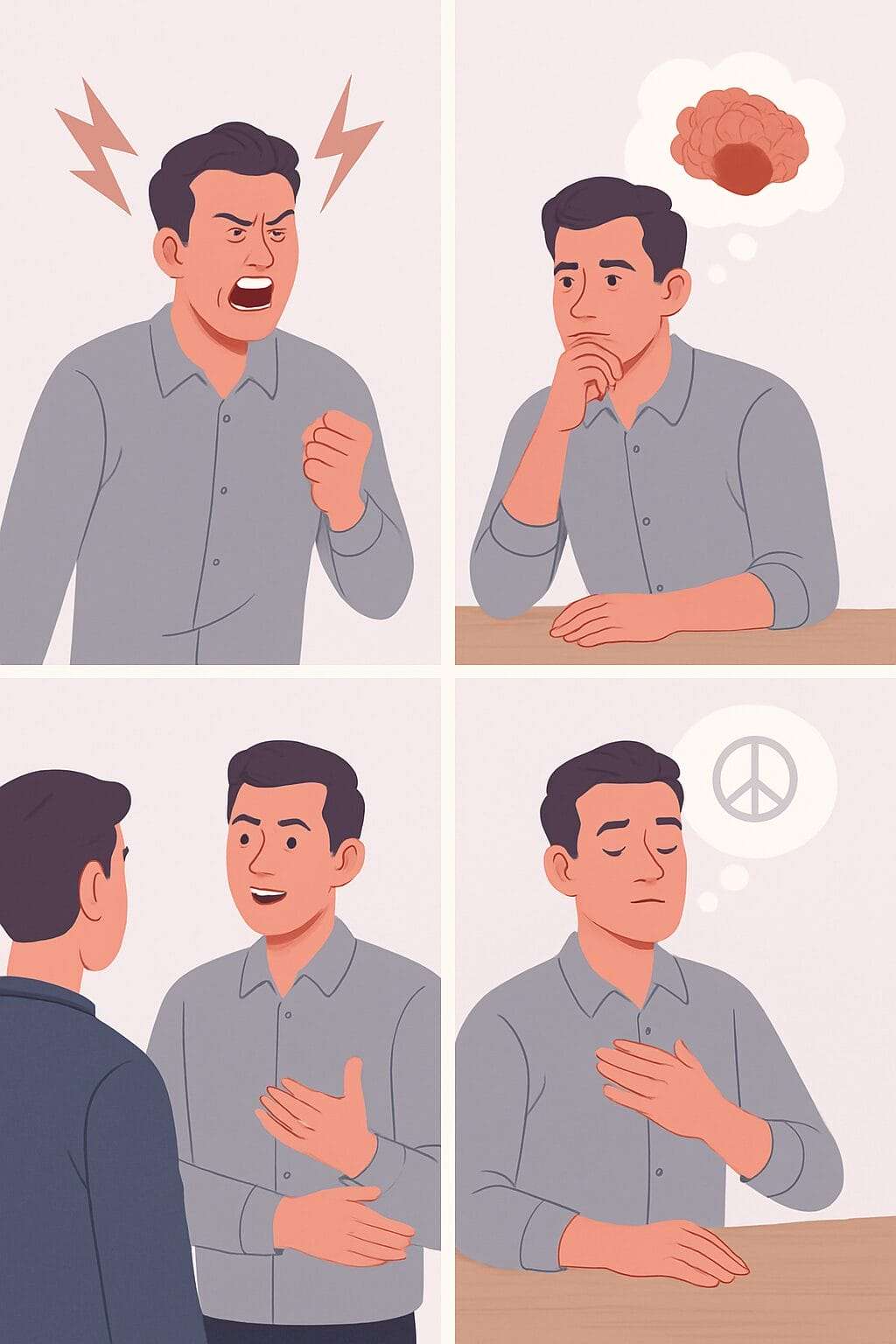
1. Notice the signal before you build the story
Start with what is happening in your body.
Your chest tightens.
Your jaw locks.
Your thoughts speed up.
You feel heat rising.
You want to interrupt, defend, accuse, withdraw, or prove something immediately.
That physical response is information.
It tells you that your system has registered a threat, violation, disappointment, or loss.
But it does not yet tell you the whole story.
Before deciding what the moment means, pause and ask:
What happened?
Not what you assume they meant.
Not what this reminds you of.
What actually happened?
That question helps separate the event from the interpretation that may already be forming around it.
2. Name what feels threatened
Anger is often protecting something important.
Your dignity.
Your safety.
Your time.
Your autonomy.
Your sense of fairness.
Your need to be respected, believed, or considered.
Ask yourself:
What feels threatened or violated right now?
The answer may be obvious.
Someone lied to you.
Ignored a clear boundary.
Publicly embarrassed you.
Failed to honor an agreement.
But sometimes the deeper answer is more vulnerable.
You feel replaceable.
Powerless.
Dismissed.
Ashamed.
Afraid that your needs will not matter unless you become forceful.
Naming that does not weaken your anger.
It makes it more precise.
3. Separate the present moment from the older emotional lesson
Once you know what hurts, ask whether the intensity belongs entirely to what is happening now.
Does this situation remind you of an earlier relationship?
Are you responding only to this person—or to everyone who made you feel the same way before?
Is an old rule shaping your reaction?
Rules like:
If they disagree with me, they do not respect me.
If they are disappointed, I have done something wrong.
If I do not respond immediately, I will lose control.
If I cannot make them understand, the truth will disappear.
The current situation may still require action.
But understanding the older lesson helps you respond to what is actually happening instead of fighting every version of the past at once.
4. Decide what the anger is asking you to do
Anger creates energy.
That does not mean every situation requires confrontation.
Sometimes anger is asking you to speak clearly.
Sometimes it is asking you to set a limit.
Sometimes it is asking you to stop participating.
Sometimes it is revealing grief that needs to be felt rather than turned into another argument.
And sometimes the healthiest response is to wait until you can act without abandoning yourself.
Ask:
What response would protect what matters without creating more damage?
That answer may be:
“I need more information before we continue.”
“I’m not willing to be spoken to that way.”
“This agreement is no longer working for me.”
“I need time before I respond.”
“I understand that you are disappointed, but my decision remains the same.”
Healthy anger gives you access to your voice.
It does not require you to surrender control of it.
5. Stop trying to force understanding
One of the hardest parts of reclaiming anger is accepting that clarity does not guarantee agreement.
You can explain yourself carefully and still be misunderstood.
You can name the harm and still receive no apology.
You can set a reasonable boundary and still be called difficult, selfish, or unfair.
Anger may tell you to keep arguing until the other person admits that you are right.
But your freedom cannot depend on someone else finally understanding what they benefit from misunderstanding.
Sometimes the most self-respecting response is not a stronger argument.
It is a decision.
You step back.
End the conversation.
Change the agreement.
Document what happened.
Seek support.
Or leave.
Not every truth needs to win a debate before you are allowed to act on it.
6. Let anger complete its job
Anger is not meant to become a permanent identity.
Once it has helped you recognize the problem and choose a response, it may need somewhere to go.
That may involve grieving what happened.
Accepting that the relationship cannot become what you hoped.
Acknowledging your own part without taking responsibility for everything.
Resting after prolonged conflict.
Or allowing your body to come down from a state of alert.
You do not have to keep rehearsing the injury to prove that it mattered.
The goal is not to forget.
It is to stop giving the violation authority over every moment that follows.
Reclaimed anger says:
Something mattered here.
I am willing to face it honestly.
I will decide what comes next.
It does not need to disappear before you act wisely.
But it can become clearer.
More grounded.
Less interested in performance.
More committed to truth.
That is what healthy anger does.
It helps you protect what matters without requiring you to lose yourself in the process.
FAQ: Reclaiming Anger Without Letting It Control You
Anger can feel confusing when you are trying to become more emotionally grounded.
You may worry that expressing it will make you destructive.
Or that calming down means minimizing what happened.
These questions can help you separate healthy anger from reaction, suppression, and self-abandonment.
What does it mean to reclaim your anger?
Reclaiming your anger means learning to listen to it without allowing it to make every decision for you.
You stop treating anger as something shameful that must be buried.
But you also stop treating it as unquestionable proof that your interpretation is correct.
Instead, you use it as information.
Something may feel unfair.
Unsafe.
Disrespectful.
Or deeply disappointing.
Your job is to understand what the anger is pointing toward, separate the facts from the story forming around them, and choose a response that reflects your values.
How do I know whether my anger is about the present or the past?
Often, it is a combination of both.
A present situation may genuinely be upsetting while also touching an older emotional wound.
One clue is intensity.
You may notice that your reaction feels much larger than the immediate event seems to explain.
You may also find yourself using absolute language:
“They always do this.”
“No one ever respects me.”
“This proves I cannot trust anybody.”
Pause and ask:
What happened in this moment?
What did I immediately decide it meant?
Where have I felt this before?
Those questions do not invalidate your anger. They help you understand everything the anger may be carrying.
Does calming down mean I am letting someone get away with what they did?
No.
Calm is not the same as agreement.
You can regulate yourself and still name what happened.
Set a boundary.
Document misconduct.
End a relationship.
Change an agreement.
Or pursue accountability.
In fact, becoming more grounded can make your response more effective because the other person has less opportunity to redirect attention from their behavior to your reaction.
You do not have to become visibly overwhelmed to prove that something mattered.
How can I express anger without hurting someone?
Start by describing the behavior and its impact instead of attacking the person’s character.
You might say:
“When that agreement changed without a conversation, I felt dismissed.”
“I am angry about how this was handled, and I need time before we continue.”
“I am not willing to remain in a conversation where I am being insulted.”
Healthy anger can be direct.
It can be firm.
It can even be uncomfortable.
But it does not require humiliation, threats, cruelty, or punishment.
What should I do if the other person refuses to understand?
Stop making understanding the requirement for your next decision.
You can explain yourself clearly and still be met with denial, defensiveness, or indifference.
At that point, continuing to argue may only keep you emotionally trapped.
You may need to ask:
What action is available to me even without their agreement?
That could mean stepping back, changing access, enforcing a consequence, seeking support, or leaving the situation entirely.
Their refusal to understand does not erase what you know.
Can anger be healthy in leadership?
Yes.
Healthy anger can alert a leader to broken trust, ethical concerns, repeated boundary violations, or a pattern that is harming the team.
But leadership requires more than emotional intensity.
Before acting, a leader must examine the facts, consider the impact of the response, and avoid using anger to intimidate or control.
The goal is not to become emotionless.
It is to use anger to clarify what requires attention without making everyone else responsible for managing your emotional state.
What if I am afraid that once I let myself feel angry, I will lose control?
That fear is common, especially if anger was explosive, dangerous, or forbidden in your childhood home.
Start by allowing yourself to notice anger before expressing it publicly.
Name what you feel in your body.
Take a walk.
Speak with someone grounded.
Give yourself time before sending the message or confronting the person.
Feeling anger does not obligate you to act immediately.
The more you practice staying present with the emotion, the less likely it is to erupt simply because it has been ignored for too long.
Your Anger Does Not Have to Disappear
Anger is not proof that you have failed at healing.
It may be evidence that something matters.
That a boundary was crossed.
That a loss has not been grieved.
That part of you is tired of accepting what once felt unavoidable.
But anger cannot complete the work by itself.
It can alert you.
Energize you.
Help you recognize what must change.
Then you have to decide what happens next.
Sometimes that means speaking.
Sometimes it means setting a boundary.
Sometimes it means acknowledging that the relationship cannot give you what you hoped it would.
And sometimes it means facing the painful truth that the person you are fighting with is not the only person in the room.
The past is there too.
Old fear.
Old humiliation.
Old powerlessness.
Old lessons about what you must do to be heard.
Reclaiming your anger means learning to recognize all of it without allowing any one moment to become the author of your life.
You do not have to swallow your anger to prove that you are mature.
You do not have to explode to prove that you were hurt.
And you do not have to keep arguing until someone else validates what you already know.
You can listen.
Discern.
Choose.
Act.
And let the emotion finish its work.
That is emotional sobriety.
Not the absence of anger.
The ability to feel it without surrendering yourself to it.
If anger keeps pulling you into reactions that do not reflect who you want to be, the Life Script Questionnaire can help you identify the emotional lesson beneath the pattern.
And when you are ready for deeper support, you can explore working with me to understand what your anger has been protecting—and develop a more grounded way to respond.
Your anger deserves attention.
It just does not need control.


