

- Updated: August 5, 2026
You’ve been told you have “quirks.”
You laugh it off because you’re still performing, still producing, still leading.
But late at night, after another scroll through your quarterly reports or another five minutes tweaking your team dashboard, you feel it:
Something is off.
You’re not melting down.
You’re not visibly falling apart.
But you can’t seem to stop.
Maybe you check your phone while your partner is in surgery.
Maybe you repeatedly monitor Slack channels, reread client emails, or research the same topic for the tenth time—not because you need more information, but because checking gives you a temporary sense of relief.
You call it focus.
Excellence.
Dedication.
But eventually, the behavior stops feeling entirely voluntary.
And it rarely stays contained to one area of your life.
The pattern can move into your work, relationships, routines, and the ways you escape discomfort. And these behaviors may serve similar emotional purposes without being the same psychological pattern.
But that does not necessarily make them the same.
A compulsion is not automatically an addiction. An addiction may include compulsive behavior, but the two terms describe different processes. Obsession can also be part of the picture, which makes the language even more confusing.
In this guide, we’ll clarify the difference between addiction and compulsion, explain where obsession fits, and examine how these patterns can remain hidden inside the lives of competent, high-functioning leaders.
Because sometimes the clearest warning sign is not that your life has fallen apart.
It is that everything still looks fine—but you no longer feel free.
🧭 What You’ll Find in This Guide
What Is Compulsion? Understanding the Urge to Repeat
Let’s start with a simple truth:
A compulsion is a repetitive behavior or mental act that a person feels driven to perform, often to reduce distress or prevent something feared from happening.

The action may not be logically connected to the feared outcome. The person may even recognize that it is excessive or unlikely to help.
But not doing it can feel unbearable.
The compulsion temporarily lowers the anxiety.
Then the doubt returns.
So the person repeats the behavior again.
That cycle can look something like this:
Distress or uncertainty → urge to act → temporary relief → renewed distress → repetition
Compulsions are strongly associated with obsessive-compulsive disorder, or OCD. In that context, an obsession is an unwanted and recurring thought, image, fear, or urge. The compulsion is the physical or mental action used to neutralize the distress it creates.
For example:
- “What if I am morally corrupt?” leads to repeated confessing, praying, or analyzing.
- “What if this decision is wrong?” leads to researching, reconsidering, and asking others for certainty.
Compulsions are not limited to visible behaviors. They can also be mental, including counting, reviewing conversations, repeating phrases, checking memories, or attempting to neutralize upsetting thoughts.
→ See how this plays out in compulsive work habits
Not Every Repetitive Behavior Is a Clinical Compulsion
The word compulsive is also used more broadly to describe behavior that feels difficult to control.
Someone may describe themselves as compulsively checking email, working, shopping, scrolling, exercising, or seeking reassurance.
Those behaviors can certainly become rigid, distressing, and disruptive. But repetition alone does not tell us what is happening psychologically.
Repeated checking may arise from obsessive fear, anxiety, learned habits, avoidance, or reward-seeking. The behavior alone does not reveal the cause.
Those patterns may overlap, but they are not automatically the same.
This distinction matters because not every driven behavior is evidence of OCD, trauma, or addiction. Sometimes the behavior is better understood by examining what happens immediately before it, what relief it provides, and what occurs when you try not to do it.
For high-functioning leaders, the pattern may hide inside behaviors that other people reward. Responsibility allows some flexibility. A compulsive pattern begins to narrow your choices.
Signs a Behavior May Be Compulsive
A behavior may deserve closer attention when:
- You feel significant distress when you resist the behavior.
- You repeat it even after receiving the reassurance or information you needed.
- It provides relief, but the relief does not last.
- You recognize that it is excessive but still feel driven to do it.
- It consumes time or interferes with sleep, work, relationships, or daily life.
Not everyone who experiences one of these signs has OCD or another mental health condition. But when a repetitive behavior is causing significant distress, taking over substantial time, or interfering with your life, it may be worth discussing with a qualified mental health professional.
Compulsion isn’t always chaos. Sometimes, it hides behind competence.
→ See how crypto trading turns into compulsion
→ Understand how love addiction hijacks your thinking
What Is Addiction? When Relief Becomes Difficult to Control
Addiction is not defined by visible collapse. You can maintain a career, care for your family, and meet deadlines while privately losing control over a substance or behavior.
You may set limits, repeatedly break them, and return to the behavior during stress despite sincerely intending to stop.
The behavior may begin with pleasure, but over time relief can become more important than enjoyment.
The pattern often begins to look like this:
Trigger or discomfort → craving or preoccupation → use or behavior → temporary relief or reward → consequences → renewed craving
That temporary relief matters.
A substance or behavior may help you escape anxiety, shame, loneliness, boredom, anger, inadequacy, or emotional disconnection. It may give you a brief sense of confidence, control, intensity, or peace.
But the relief comes with a growing cost.
You need the pattern more often.
You spend more time thinking about it.
You organize parts of your life around it.
And you continue despite mounting evidence that it is harming you.
Addiction Is More Than Doing Something Too Much
People often use addicted casually to describe work, phones, relationships, approval, or productivity. These patterns may be consuming and harmful, but not every difficult-to-stop behavior is a clinical addiction.
The behavior alone does not give us the entire answer.
The Core Signs of Addiction
Although addiction can take different forms, several features commonly appear.
| Signs | What it Looks Like |
|---|---|
| Impaired control | You use more, stay longer, spend more, or engage more frequently than you intended. |
| Increasing priority | The substance or behavior begins taking up more mental and practical space. |
| Continuing despite consequences | You know the pattern is damaging your health, sleep, finances, work, relationships, or self-respect. |
| Escalation or tolerance | You may need more of the substance, greater intensity, longer periods, or riskier experiences to achieve the same effect. |
| Withdrawal or significant distress | When you stop, you may experience physical withdrawal, depending on the substance. This doesn’t just apply to substances. |
Addiction vs. Compulsion: Where They Overlap—and Where They Don’t
An addictive behavior can become compulsive.
You may no longer enjoy it the way you once did, but still feel driven to repeat it.
A compulsive behavior can also provide a rewarding sense of relief, certainty, or control.
And the same person may move between anxiety, craving, escape, and emotional relief depending on the situation.
The issue is not merely how often you do something. It is how much freedom you still have around it.
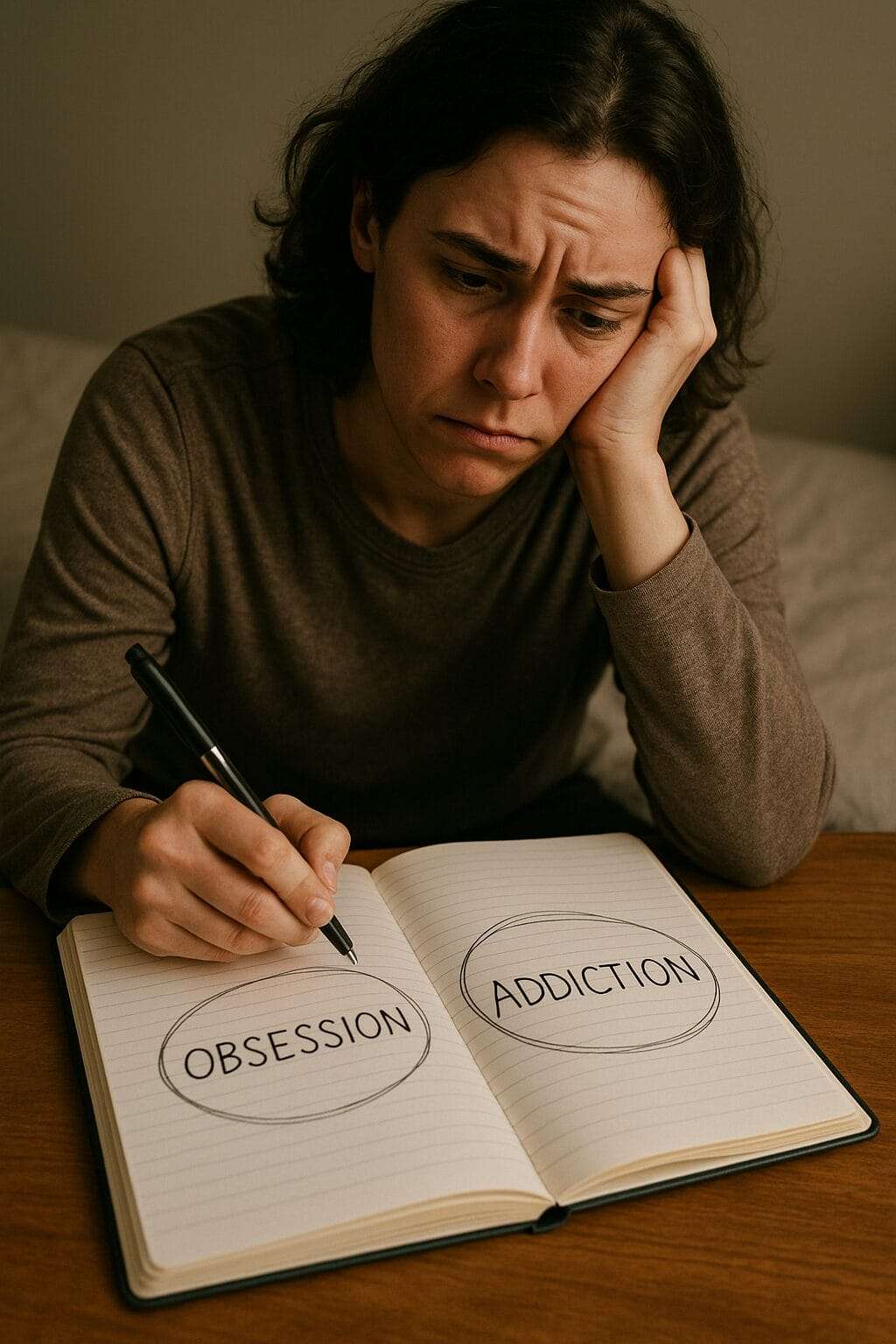
Generally, a compulsion is driven by the need to reduce distress, neutralize a fear, or quiet the feeling that something is wrong.
The internal message sounds like:
I have to do this, or I won’t feel safe.
Addiction is more often organized around craving, reward, relief, or the need to change how you feel.
Its message sounds more like:
I need this to feel better, feel different, or get through what I’m feeling.
That distinction matters.
But it is not always neat.
How Addiction and Compulsion Show Up in High-Functioning Leaders
Leaders are often rewarded for the very behaviors that may be quietly draining them.
But there is a difference between choosing to work hard and feeling unable to stop.

There is a difference between preparing carefully and repeatedly checking because uncertainty feels unbearable.
There is a difference between enjoying recognition and depending on it to feel steady inside yourself.
That difference is often invisible from the outside.
Compulsion Can Look Like Responsibility
A compulsive leadership pattern may show up as:
- checking messages repeatedly, even when nothing urgent is happening;
- reviewing completed work because it never feels fully settled;
- asking for reassurance while struggling to believe the answer;
You may tell yourself that you are being thorough.
And sometimes you are.
But thoroughness still allows you to decide when enough is enough.
Compulsion makes enough difficult to feel.
Addiction Can Hide Inside Performance
An addictive pattern may show up differently.
But the behavior alone does not tell the whole story.
The deeper issue is the relationship you have with it.
Can you stop without becoming consumed by the urge?
Can you tolerate the feelings that emerge when it is unavailable?
Can you recognize the consequences without immediately minimizing them?
Can you choose something different—or does the pattern keep choosing for you?
Why High-Functioning People Can Miss the Problem
Many leaders believe they will know something is wrong when their performance collapses.
But performance is often the last thing to go.
You may still be delivering results while becoming emotionally unavailable at home.
You may still be making money while sacrificing sleep.
You may still be leading meetings while privately planning the next drink, escape, encounter, purchase, or opportunity to disappear.
You may still look calm while your mind is scanning, rehearsing, checking, and preparing for threats no one else can see.
This is what makes high-functioning patterns so deceptive.
You do not always receive concern.
Sometimes, you receive applause.
People praise your work ethic without seeing that you cannot rest.
They admire your attention to detail without seeing the anxiety beneath it.
They depend on your strength without realizing how much of it is being held together by fear, secrecy, or emotional escape.
You do not get an intervention.
You get rewarded.
And because the consequences are mostly happening inside you—or behind closed doors—you can continue telling yourself that the problem is not serious enough yet.
But you do not have to wait for your life to collapse before you become honest about what it is costing you.
Andy’s Story: When Control Becomes Part of the Escape
Andy did not think he had an addiction.
He thought he had a demanding job, a high sex drive, and a complicated marriage.
From the outside, Andy was successful, respected, and dependable under pressure.
But privately, he had started organizing more of his life around sexual attention.
At first, it felt like relief.
A message from someone new gave him something to anticipate.
Flirtation made him feel wanted.
Fantasy gave him somewhere to disappear when work, marriage, or ordinary life felt flat.
He told himself it was harmless because he was still handling his responsibilities.
Then the pattern began to grow.

One conversation became several.
What once felt exciting started feeling necessary.
He needed more novelty, more risk, and more reassurance that he could still attract someone.
He spent increasing amounts of time planning, hiding, deleting, and recovering from what he was doing.
He promised himself he would stop.
Sometimes he did—for a few days or even a few weeks.
But the moment he felt rejected, powerless, bored, ashamed, or emotionally cornered, the urge returned.
That is when Andy began to realize that sex was not the only thing he was chasing.
He was chasing a particular version of himself.
Desired.
Powerful.
At work, Andy was responsible for outcomes he could not always predict.
At home, he could not control how his wife felt about him or whether she would give him the kind of attention he wanted.
But inside fantasy, flirtation, and sexual pursuit, he could create a world where he felt chosen.
At least temporarily.
Then the high faded.
The secrecy remained.
So did the anxiety that someone would discover what he had been doing.
He wanted intimacy, but he also experienced closeness as a threat because closeness required honesty.
The behavior that helped him escape vulnerability was now making genuine connection almost impossible.
Was It Addiction, Compulsion, or Both?
Andy’s pattern contained both addictive and compulsive elements:
- craving,
- escalation,
- broken promises,
- continued behavior despite harm,
- and an urgent need to escape rejection and powerlessness.
Understanding its emotional function did not excuse his dishonesty. It explained why discipline alone had not changed him.
He had to learn to tolerate rejection and uncertainty without seeking validation, regain control through another person, or hide behind secrecy.
Discipline had helped him hide it. Healing required honesty about what the behavior gave him—and what it was taking away.
Healing Is More Than Stopping the Behavior
Stopping matters.
But stopping is not the same as healing.
You can remove the alcohol and remain controlled by shame.
You can put down one coping strategy and immediately pick up another.
The substance disappears.
The behavior changes.
But the emotional pattern remains.
This is why recovery requires more than discipline.
You have to understand what the behavior was doing for you.
Did it help you escape?
Feel powerful?
Feel wanted?
Punish yourself?
Keep you from sitting still long enough to feel what was underneath?
The goal is not to excuse the behavior.
Your pain does not erase the harm you caused.
Trauma does not remove accountability.
But shame alone rarely creates lasting change.
If hating yourself could have healed you, it would have worked by now.
Because healing isn’t just abstinence.
It’s retraining your nervous system to feel safe without the crutch.

You Have to Learn How to Stay
Many addictive and compulsive patterns are built around leaving.
Leaving the moment.
Leaving an uncomfortable emotion.
Leaving the uncertainty of not knowing what another person thinks or whether everything will work out.
Healing asks you to stay.
To feel disappointment without immediately numbing it.
To experience rejection without chasing proof that you still matter.
To tolerate uncertainty without checking, fixing, controlling, or rehearsing every possible outcome.
None of this feels natural at first.
You may have spent years teaching yourself that discomfort was dangerous.
Recovery teaches you that discomfort can be painful without being an emergency.
Recovery Restores Choice
The goal is not to become someone who never feels an urge.
It is to become someone who has more room between the urge and the response.
You notice what is happening.
You tell the truth about it.
You reach for support before the pattern takes over.
You allow the feeling to rise and fall without automatically obeying it.
Sometimes you will still want the old relief.
But wanting something is not the same as having to do it.
That space is where freedom begins.
What Deeper Recovery May Require
Depending on the pattern, healing may include:
- appropriate medical, mental health, or addiction treatment;
- honest support and accountability;
- boundaries that reduce access to the pattern;
- learning healthier ways to regulate emotion, grieve, and repair harm.
You learn that safety is not the same as control.
You learn that relief which costs your integrity is not freedom.
Healing does not give you perfect control over yourself.
It gives you a more honest relationship with choice.
And slowly, the behavior that once felt larger than you becomes something you can see clearly without automatically surrendering to it.
You don’t need a stricter routine.
You need a different relationship with yourself.
This includes learning how to forgive yourself after addiction.
❓Frequently Asked Questions About Addiction and Compulsion
Can a behavior be both addictive and compulsive?
Yes.
An addictive behavior can become compulsive over time. You may no longer enjoy it the way you once did, but still feel driven to repeat it.
The pattern may involve craving, emotional relief, anxiety reduction, impaired control, or all of these at once.
That is why the question is not always:
Which label fits perfectly?
Sometimes the more useful questions are:
What is driving this behavior? What happens when I try to stop? And how much is it interfering with my life?
How do I know when a pattern has become a serious problem?
A pattern deserves closer attention when:
- repeated failed efforts to stop;
- meaningful interference with life;
- secrecy or minimization;
- escalation or significant distress when unable to engage.
You do not have to wait until everything falls apart.
The fact that you are still functioning does not mean the pattern is harmless.
Do I need therapy, treatment, coaching, or a support group?
That depends on the pattern and its severity.
Substance use, dangerous withdrawal, severe compulsions, OCD symptoms, trauma, self-harm, and behaviors that place you or others at risk should be addressed with appropriately qualified medical or mental health professionals.
Support groups can also provide structure, accountability, and connection for people recovering from addiction or compulsive behavior.
Coaching may be helpful later or alongside treatment when the focus is leadership, relationships, emotional patterns, boundaries, and rebuilding your life.
But coaching should not replace medical care, addiction treatment, or mental health treatment when those services are needed.
Choose the level of help that matches what is actually happening.
👉 Curious about coaching or therapy? Learn more about the differences here
You’re Not Broken—But the Pattern May Be Running Your Life
You do not have to lose everything before you take your life seriously.
You do not have to wait until your work collapses, your partner leaves, or someone discovers what you have been hiding.
High-functioning people often wait because they can still point to everything they are managing.
They are still producing.
But functioning is not the same as being free.
And survival is not the same as being well.
The behavior may have helped you once.
It may have helped you endure loneliness, fear, rejection, shame, pressure, or uncertainty when you did not have another way to respond.
That does not make the consequences harmless.
It does not remove your responsibility for the choices you made or the people you hurt.
But it does mean you are not beyond help.
You are not weak because part of you still reaches for what once brought relief.
Healing begins when you stop asking only:
How do I make myself stop?
And begin asking:
What am I trying not to feel?
What does this pattern promise me?
What support or truth would help me live differently?
The goal is not perfection.
It is presence.
And every time you tell the truth, reach for appropriate support, or choose not to disappear into the old pattern, you are building a life that no longer has to be organized around escape.
Ready to Look Beneath the Pattern?
My coaching is not addiction treatment or a replacement for medical, mental health, or recovery support. It is for leaders ready to examine the emotional patterns shaping how they work, relate, perform, and cope.
If you are ready to explore what is happening beneath the behavior and build a more honest relationship with yourself, you can begin with my Life Script Questionnaire.
It can help you identify the emotional lessons and survival patterns that may still be influencing your leadership, relationships, and ability to feel safe.


